
When a younger person is diagnosed with cancer, the question that often follows is, “Why?” Some blame their genes. Others look back and blame their food, sleep, or lifestyle.
Most cancers do not arise from a single cause. They reflect cellular changes accumulated over time together with inherited susceptibility, environment, lifestyle, infections, hormones, immunity, and many other influences across the life course.
Cancer in a young adult should never be interpreted as proof that the person “failed to take care of themselves.” It is not the patient's fault.
Is This Trend Real?
Data from several countries show rising incidence of certain cancers in younger adults—particularly colorectal cancer, as well as breast, kidney, pancreatic, endometrial, and some gastrointestinal cancers. However, not every cancer is increasing among young people in every country. Trends vary by population, sex, cancer type, and time period.
In US data, people born around 1990 had approximately twice the risk of colon cancer and four times the risk of rectal cancer compared with those born around 1950 at a similar age. These are population-level observations, not predictions of an individual's personal risk.
The Exposome: What the Body Encounters Across a Lifetime
Scientists use the word exposome to describe the totality of exposures from the womb onward—including diet, pollution, chemicals, infections, medications, sleep, stress, physical activity, social conditions, and the broader environment.
These factors may influence inflammation, metabolism, hormones, the gut microbiome, and epigenetic control of gene activity, particularly during developmental windows such as pregnancy, childhood, and adolescence. This remains an active field of research and does not yet explain the full rise in early-onset cancers.
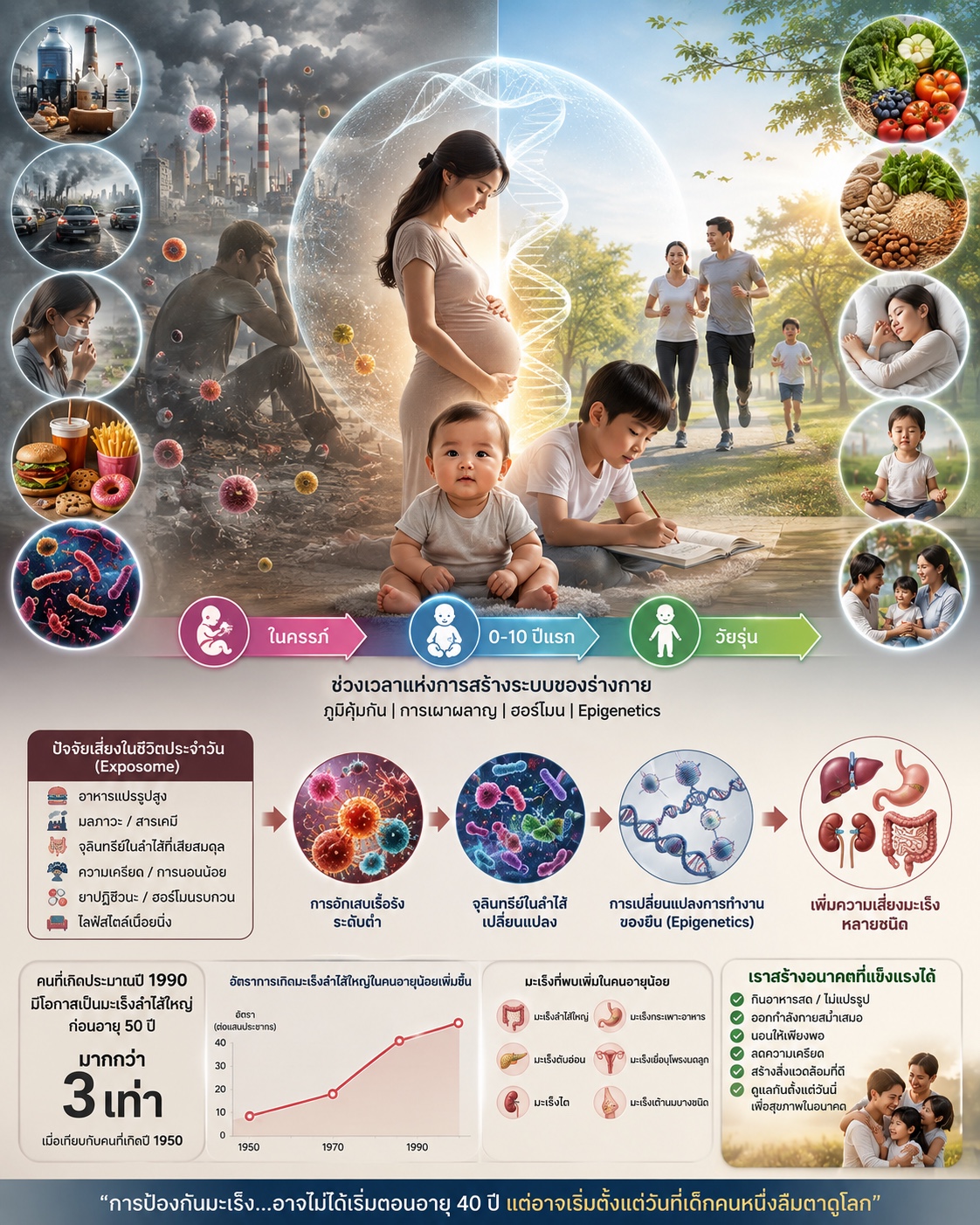
Which Factors Are Being Studied?
- Excess body weight, obesity, and metabolic dysfunction
- Ultra-processed foods, processed meat, sugary drinks, and low-fiber dietary patterns
- Physical inactivity and prolonged sitting
- Alcohol, tobacco, air pollution, and occupational or environmental carcinogens
- Cancer-related infections such as HPV, hepatitis B and C, and H. pylori
- Changes in the gut microbiome, certain medications, and sleep patterns—areas where the strength of evidence varies
An association in a study does not necessarily prove causation, and no single factor should be used to blame a patient.
How Can We Build a Healthier Future?
- Choose mostly fresh or minimally processed foods, with more vegetables, fruit, whole grains, legumes, and fiber
- Limit processed meat, ultra-processed foods, sugary drinks, and alcohol
- Move regularly, exercise consistently, and maintain a healthy weight
- Do not smoke and reduce exposure to secondhand smoke and pollution where possible
- Receive HPV and hepatitis B vaccination when indicated
- Protect sleep and mental health, and create healthier environments for the whole family
Do Not Wait for Screening Age When Symptoms Are Present
Age thresholds for average-risk screening differ between countries. But symptoms—such as blood in the stool, a persistent change in bowel habits, unexplained weight loss, a new lump, abnormal bleeding, a persistent cough, or any unexplained problem that does not resolve—deserve medical assessment at any age.
People diagnosed unusually young, those with several relatives affected by cancer, multiple primary cancers, or characteristic tumor patterns should discuss genetic counseling and appropriate germline testing.
What I Want You to Know
Cancer prevention may not begin at age 40. It may begin from the day a child enters the world—and it requires families, communities, and policies that make healthy choices realistically possible.
We cannot change the past or reduce cancer risk to zero. But we can build a healthier future through small, consistent actions—without blaming ourselves or anyone else.
Take care of yourself—with care from Dr. Nine 🩷
References
- Ugai T, et al. Is early-onset cancer an emerging global epidemic? Current evidence and future implications. Nat Rev Clin Oncol. 2022;19:656–673. View source ↗
- Sung H, et al. Emerging cancer trends among young adults in the USA: analysis of a population-based cancer registry. Lancet Public Health. 2019;4:e137–e147. View source ↗
- Zhao J, et al. Global trends in incidence, death, burden and risk factors of early-onset cancer from 1990 to 2019. BMJ Oncology. 2023;2:e000049. View source ↗
- Siegel RL, et al. Colorectal Cancer Incidence Patterns in the United States, 1974–2013. J Natl Cancer Inst. 2017;109:djw322. View source ↗
- Wild CP. Complementing the genome with an “exposome”: the outstanding challenge of environmental exposure measurement in molecular epidemiology. Cancer Epidemiol Biomarkers Prev. 2005;14:1847–1850. View source ↗
This article provides general educational information. It does not identify an individual's cause or personal risk and does not replace medical assessment or advice.